Diabetes Insights - Breakthroughs and Innovators

EASD presents: Diabetes Insights - Breakthroughs and Innovators
Join us for expert interviews and discussions on the latest advances in diabetes research. Discover how groundbreaking medicines and cutting-edge technologies are shaping the future of diabetes treatment and management.
Get inspired by the stories of distinguished researchers whose discoveries and contributions have transformed our understanding of diabetes.
These podcasts were recorded at the EASD Annual Meeting 2024 in Madrid, Spain. You can learn more about the research discussed by watching the scientific presentations in the EASD Media Centre (https://www.easd.org/media-centre/home.html).
New episode released every Friday.

Diabetes Insights - Breakthroughs and Innovators

Latest episodes

SURPASS-CVOT: A comparison of Tirzepatide and Dulaglutide

SURPASS-CVOT: A comparison of Tirzepatide and Dulaglutide

10m 0s

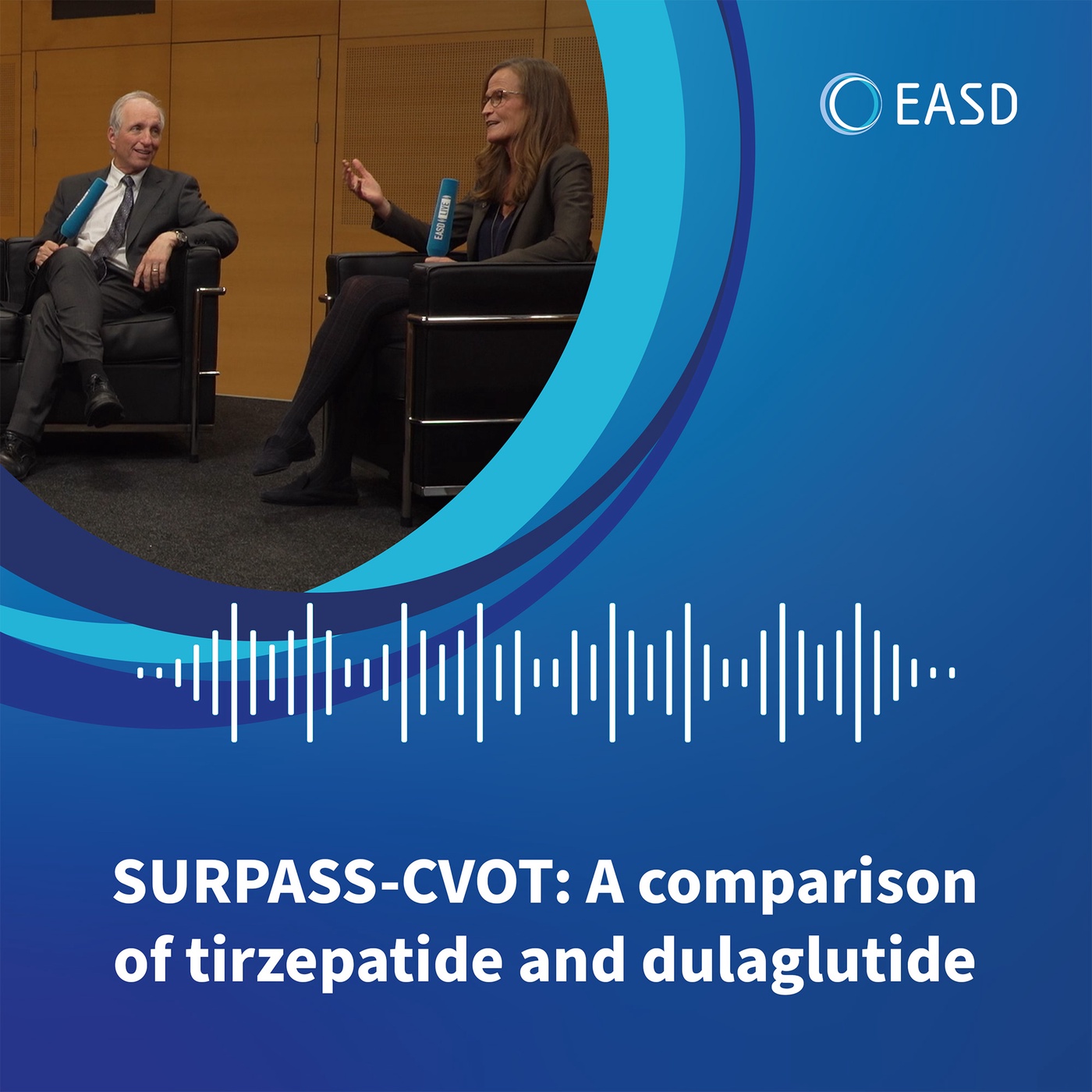
In this weeks episode of Diabetes Insights - Breakthroughs and Innovators, experts discuss the highly anticipated SURPASS CVOT trial, a head-to-head cardiovascular outcomes study comparing tirzepatide 15 mg weekly with dulaglutide 1.5 mg weekly in people with type 2 diabetes. With over 13,000 participants, the trial demonstrates that tirzepatide provides equivalent cardioprotective benefits to dulaglutide, confirming its role in improving both glycaemic control and cardiovascular outcomes.

EASD TV Host Vivienne Parry sits with Prof. Tina Vilsbøll (EASD Honorary Secretary) and Prof. Hertzel Gerstein (EASD Independent Advisor and McMaster University) to unpack the trial’s implications for clinical practice, highlighting how outcomes...
What are the Hot Topics in Diabetes Research from a Journal's Perspective - Diabetologia

What are the Hot Topics in Diabetes Research from a Journal's Perspective - Diabetologia

14m 37s

In our first episode of 2026, Prof. Hindrik Mulder, Editor-in-Chief of Diabetologia, offers a journal’s-eye view of the most exciting and challenging developments in diabetes research today.

Drawing on his unique overview of submissions from across the global research community, prof. Mulder discusses emerging breakthroughs such as hypoimmune stem cell-based therapies that are transforming from theoretical possibilities into scalable, off-the-shelf treatments for diabetes. Prof. Mulder discusses how these innovations could revolutionise diabetes care by overcoming the historical barriers of islet transplantation.

We further explore Diabetologia's special 2025 issue on "Opportunities and Challenges in Diabetes," which tackles the critical issues of...

SURPASSing Therapeutic Challenges of Paediatric Type 2 Diabetes with Tirzepatide

SURPASSing Therapeutic Challenges of Paediatric Type 2 Diabetes with Tirzepatide

12m 37s

In this episode, Dr. Tamara Hannon (Indiana University Health) and Prof. Martin Wabitsch (Universtätsklinikum Ulm) unpack the findings of the SURPASS-PEDS trial - the first study to evaluate the dual GIP/GLP-1 receptor agonist tirzepatide in adolescents with type 2 diabetes.

With youth-onset type 2 diabetes rising sharply across the US and Europe, and with young people experiencing faster beta-cell decline, more severe obesity, and greater socioeconomic burdens, the need for effective therapies has never been greater. They discuss why adolescent disease differs fundamentally from adult type 2 diabetes, why weight-loss expectations cannot be compared across age groups, and how tirzepatide...

The EASD's First Clinical Guideline: Assessment and Management of Diabetes Distress

The EASD's First Clinical Guideline: Assessment and Management of Diabetes Distress

16m 19s

In this episode, EASD presents its inaugural clinical guideline on diabetes distress. Drawing on two years of multidisciplinary work, the guideline was developed by clinicians, methodologists, psychologists and people with lived experience. Prof. Jane Speight, Prof. Richard Holt and patient-advocate Michelle Law describe what diabetes distress is (the emotional burden tied to daily self-management) and why routine assessment and supportive care must become part of standard practice.

The guideline sets out eight good practice statements to help clinicians normalise conversations about emotional wellbeing, plus graded recommendations for managing distress in adults with type 1 and type 2 diabetes. Psychological interventions...